Abra Stone–Bradley Trevor relationship
Doctor SleepAbra Stone’s relationship with Bradley Trevor is brief in direct experience but consequential in what she remembers and discovers: her psychic perception turns the image of a missing child into a specific person, a burial site, and evidence of the True Knot’s violence. Bradley is not presented as a continuing companion in Abra’s life. Instead, their connection persists through a fragmentary encounter, a photograph, and the baseball glove found with his remains. Through those traces, Abra becomes a witness to what happened to him and helps make his disappearance materially legible to others.
A Fragmentary Encounter
Abra remembers Bradley from an encounter two years earlier. Her recollection is limited, but its clearest elements are sharply defined: flashlight beams crossing over him as he lay on the ground, and his screams. She understands that the group responsible described its activity as an operation, while recognizing that what she had perceived was torture. The memory supplies the first basis for her connection to him, though it is not a conventional friendship built through shared time or conversation.
When Abra later sees Bradley’s picture on the missing-children page in The Anniston Shopper, she recognizes him and reaches toward the photograph to learn more. The act joins an ordinary printed image to her unusual ability: the photograph is both a public notice about a missing boy and a point of contact through which Abra can seek knowledge. Her discovery is therefore neither a complete recollection nor a detached investigation. It develops from the overlap between an earlier, distressing perception and a later attempt to understand the person represented in the picture.
Naming Bradley and Seeking Help
Abra tells Dan Torrance that Bradley is dead and that his killers hurt him before killing him. As she speaks, her lower lip trembles and she briefly appears younger than her age. She steadies herself with several breaths, then explains that she is relieved not to be alone with what she has been carrying in her mind. Her account makes the burden of the connection explicit: knowing about Bradley means holding the memory of his suffering without yet having the support or proof needed to answer it.
Dan listens as she describes what she remembers and asks whether he can sometimes learn things by touching objects. His own ability is less reliable than it was when he was a child, but the exchange establishes a shared framework for understanding her perceptions. Abra is not merely reporting a disturbing image to someone who dismisses it; Dan recognizes that this kind of knowledge can be real, while also responding to the limits of what it can establish.
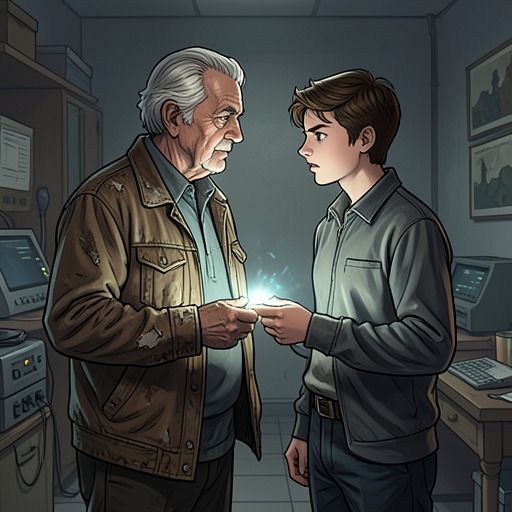
Abra tells Dan that she is fairly sure she knows where Bradley was killed and buried, and that his baseball glove was buried there too. She gives him a copy of a sheet of paper bearing names she had written repeatedly. The page preserves the intensity of her private preoccupation, but it also marks a turn toward action: rather than keeping the discovery inside her own thoughts, she gives Dan something he can examine and asks him to help pursue what she has learned.
The Glove and the Search
The glove becomes the concrete center of Abra’s effort to act on Bradley’s behalf. She reasons that if she can get it, she will be able to locate Barry the Chunk, and that the other members of the group will be found with him. She asks Dan to retrieve it, both to identify the people responsible and, if killing them proves impossible, to report them to the police. Her request connects the personal memory of Bradley to a wider fear that other children have been taken and may be in danger.
Dan later follows Abra’s directions to the burial place while she remains in her bed. As he moves, he experiences her tears through their psychic connection; she is shaking and clutching her stuffed rabbit as she guides him to the spot. The scene makes the distance between them and the intimacy of the connection coexist: Abra cannot physically accompany him, yet her perception directs his steps, and his experience is affected by her distress. Her instruction identifies the place where he is standing over the buried boy.
The recovery takes twenty minutes. Dan digs for the first ten before passing the spade to John Dalton, who finds Bradley. As they uncover the body, they discover the glove held against the boy’s chest. Its presence confirms a specific detail Abra had conveyed and gives the object she sought a double significance: it is a means by which she hopes to trace the killers, and it is also a final physical connection to Bradley, preserved in the place where he was buried.
Witness, Evidence, and Aftermath
The discovery converts Abra’s psychic knowledge into evidence that Dan and John can encounter directly. Her impressions had identified Bradley, connected his image to the missing-children notices, and directed Dan to the burial site; the recovered remains and glove corroborate crucial parts of what she said. The process does not make her earlier experience less personal. Instead, it gives that experience an outward consequence, allowing others to share responsibility for what had previously been isolated inside her mind.
The relationship is therefore defined by asymmetry and belated recognition. Bradley cannot explain what happened to him, and the evidence does not establish that he and Abra had a sustained relationship before his death. Abra’s remembered image, the photograph, and the glove form the available links. Through them, she moves from seeing Bradley as one of the missing children to identifying him as a particular boy whose death can be located and whose killers may still be found. Her connection to him functions as testimony: incomplete in its first appearance, painful to carry alone, and decisive once she acts on it.